What Does Easter Mean to You?
3/27/2024
This coming Sunday is Easter. A time of worship, time with family, and children enjoying their baskets of candy. Have you ever stopped to think about the real meaning of Easter? More importantly, have you ever thought about what you would have done had you been there in A.D. 33?
There is actually a lot that goes into the week that many people don’t think about. Their focus might be on the family get-together they are going to have. Or maybe getting new Easter outfits for church is important to them. For some, it is just another day on the calendar.
But I want to challenge you to think about Easter. What does it mean for us today?
First, what happened on that day that we celebrate as Easter now? It really started a week earlier.
Jesus entered Jerusalem on what we call Palm Sunday. People lined the streets shouting Hosanna in the highest. They thought Jesus came to free them from Rome. But 7 days later many of these same people would be shouting for Christ to be crucified. Is that what you would have done as well?
Jesus did many things during the week leading up to His death.
Then Thursday night he is having a meal with His disciples. They were likely having the traditional Passover meal. As they were all eating and talking, Jesus made what to them must have seemed a very odd statement. This is recorded in Matthew 26, verses 20-24. This is from the New International Version.
——————————————————-
‘’20 When evening came, Jesus was reclining at the table with the Twelve.
21 And while they were eating, he said, “Truly I tell you, one of you will betray me.”
22 They were very sad and began to say to him one after the other, “Surely you don’t mean me, Lord?”
23 Jesus replied, “The one who has dipped his hand into the bowl with me will betray me.
24 The Son of Man will go just as it is written about him. But woe to that man who betrays the Son of Man! It would be better for him if he had not been born.”
——————————————————-
Think about it. They were just sitting there enjoying a meal. And Jesus suddenly says that one of them is going to betray Him. These men had been with Jesus for the last 3 years. Daily they saw Him perform miracles, heard His teachings, walked with Him, talked with Him, laughed with Him.
Now he suddenly says one of them will betray Him. One after another they ask if it is me. These men who loved Christ and gave up their lives to follow Him, now all begin to doubt their loyalty to Him.
I often think about what I would have done when I read these verses. Would I have been so confident in my love for Christ that I sat there saying, ‘’It’s not me.’’ Or would I have been so humbled by this announcement that I would think I could be the one to betray Him?
Then after supper, they went to the garden of Gethsemane. Jesus asks Peter, James, and John to follow Him to pray. The three men couldn’t stay awake and fell asleep each time Jesus wakes them. I would have probably done the same. But how that must have hurt Jesus. The three men who were closest to Him, couldn’t stay awake to lift Him up in prayer.
Judas comes after that and betrays Jesus. Jesus is led away to be tried by the Jewish leaders. Then on to the Roman governor. There He is tortured and abused. I have read these verses many times in the Bible. But I never understood what Jesus really went through from the time He was taken in the garden to when He was crucified.
Some years ago, I came across an article about the crucifixion of Jesus. It was written by a physician. It is by Dr. C. Truman Davis and titled ‘’A Physician’s View of the Crucifixion of Jesus Christ’’. Following is an excerpt from the article. The full article can be found on the CBN.com website. Warning, this is a graphic explanation of what happened to Jesus.
——————————————————-
‘’After the arrest in the middle of the night, Jesus was next brought before the Sanhedrin and Caiphus, the High Priest; it is here that the first physical trauma was inflicted. A soldier struck Jesus across the face for remaining silent when questioned by Caiphus. The palace guards then blind-folded Him and mockingly taunted Him to identify them as they each passed by, spat upon Him, and struck Him in the face.
In the early morning, battered and bruised, dehydrated, and exhausted from a sleepless night, Jesus is taken across the Praetorium of the Fortress Antonia, the seat of government of the Procurator of Judea, Pontius Pilate. You are, of course, familiar with Pilate’s action in attempting to pass responsibility to Herod Antipas, the Tetrarch of Judea. Jesus apparently suffered no physical mistreatment at the hands of Herod and was returned to Pilate.
It was then, in response to the cries of the mob, that Pilate ordered Bar-Abbas released and condemned Jesus to scourging and crucifixion. There is much disagreement among authorities about the unusual scourging as a prelude to crucifixion. Most Roman writers from this period do not associate the two. Many scholars believe that Pilate originally ordered Jesus scourged as his full punishment and that the death sentence by crucifixion came only in response to the taunt by the mob that the Procurator was not properly defending Caesar against this pretender who allegedly claimed to be the King of the Jews. Preparations for the scourging were carried out when the Prisoner was stripped of His clothing and His hands tied to a post above His head. It is doubtful the Romans would have made any attempt to follow the Jewish law in this matter, but the Jews had an ancient law prohibiting more than forty lashes. The Roman legionnaire steps forward with the flagrum (or flagellum) in his hand. This is a short whip consisting of several heavy, leather thongs with two small balls of lead attached near the ends of each. The heavy whip is brought down with full force again and again across Jesus’ shoulders, back, and legs.
At first the thongs cut through the skin only. Then, as the blows continue, they cut deeper into the subcutaneous tissues, producing first an oozing of blood from the capillaries and veins of the skin, and finally spurting arterial bleeding from vessels in the underlying muscles. The small balls of lead first produce large, deep bruises which are broken open by subsequent blows. Finally, the skin of the back is hanging in long ribbons and the entire area is an unrecognizable mass of torn, bleeding tissue. When it is determined by the centurion in charge that the prisoner is near death, the beating is finally stopped. The half-fainting Jesus is then untied and allowed to slump to the stone pavement, wet with His own blood.
The Roman soldiers see a great joke in this provincial Jew claiming to be king. They throw a robe across His shoulders and place a stick in His hand for a scepter. They still need a crown to make their travesty complete. Flexible branches covered with long thorns (commonly used in bundles for firewood) are plaited into the shape of a crown and this is pressed into His scalp. Again there is copious bleeding, the scalp being one of the most vascular areas of the body.
After mocking Him and striking Him across the face, the soldiers take the stick from His hand and strike Him across the head, driving the thorns deeper into His scalp. Finally, they tire of their sadistic sport and the robe is torn from His back. Already having adhered to the clots of blood and serum in the wounds, its removal causes excruciating pain just as in the careless removal of a surgical bandage, and almost as though He were again being whipped the wounds once more begin to bleed. In deference to Jewish custom, the Romans return His garments. The heavy patibulum of the cross is tied across His shoulders, and the procession of the condemned Christ, two thieves, and the execution detail of Roman soldiers headed by a centurion begins its slow journey along the Via Dolorosa.
In spite of His efforts to walk erect, the weight of the heavy wooden beam, together with the shock produced by copious blood loss, is too much. He stumbles and falls. The rough wood of the beam gouges into the lacerated skin and muscles of the shoulders. He tries to rise, but human muscles have been pushed beyond their endurance. The centurion, anxious to get on with the crucifixion, selects a stalwart North African onlooker, Simon of Cyrene, to carry the cross. Jesus follows, still bleeding and sweating the cold, clammy sweat of shock, until the 650 yard journey from the fortress Antonia to Golgotha is finally completed. Jesus is offered wine mixed with myrrh, a mild analgesic mixture. He refuses to drink. Simon is ordered to place the patibulum on the ground and Jesus quickly thrown backward with His shoulders against the wood. The legionnaire feels for the depression at the front of the wrist. He drives a heavy, square, wrought-iron nail through the wrist and deep into the wood. Quickly, he moves to the other side and repeats the action, being careful not to pull the arms too tightly, but to allow some flexion and movement. The patibulum is then lifted in place at the top of the stipes and the titulus reading, “Jesus of Nazareth, King of the Jews,” is nailed in place.
The left foot is now pressed backward against the right foot, and with both feet extended, toes down, a nail is driven through the arch of each, leaving the knees moderately flexed. The Victim is now crucified. As He slowly sags down with more weight on the nails in the wrists, excruciating pain shoots along the fingers and up the arms to explode in the brain — the nails in the wrists are putting pressure on the median nerves.
As He pushes Himself upward to avoid this stretching torment, He places His full weight on the nail through His feet. Again there is the searing agony of the nail tearing through the nerves between the metatarsal bones of the feet. At this point, as the arms fatigue, great waves of cramps sweep over the muscles, knotting them in deep, relentless, throbbing pain. With these cramps comes the inability to push Himself upward. Hanging by his arms, the pectoral muscles are paralyzed and the intercostal muscles are unable to act. Air can be drawn into the lungs, but cannot be exhaled. Jesus fights to raise Himself in order to get even one short breath. Finally, carbon dioxide builds up in the lungs and in the blood stream and the cramps partially subside. Spasmodically, he is able to push Himself upward to exhale and bring in the life-giving oxygen.’’
——————————————————-
I cried the first time I read what Jesus really went through. It wasn’t a clean and sterilized version we think of. Jesus did not have to go through this AT ALL. He could have said no, or called armies of angels to protect Him.
But He didn’t. He followed God’s plan, His Father, to be the sacrifice for each one of us. He died so that each one of us may have our sins totally forgiven and washed away. The Bible says as far as the East is to the West, so has God put our sins away from us. Another verse says our sins are put into the sea of forgetfulness where God remembers them no more. Both of these verses are Mike’s paraphrased version. Jesus did this so that we can be free from sin.
As bad as the above description was of the crucifixion of Jesus, I think the worst part for Him had to be when He cried out. ‘’My God, my God, why has thou forsaken me?’’
God the Father cannot allow sin in His sight. At that moment on the cross, Jesus became the sin for all of mankind that lived then and ever would live. And at that moment, I am guessing that when God the Father turned His face away, Jesus felt all alone. He was God, but He was also a man. I can’t even begin to understand what He went through right then.
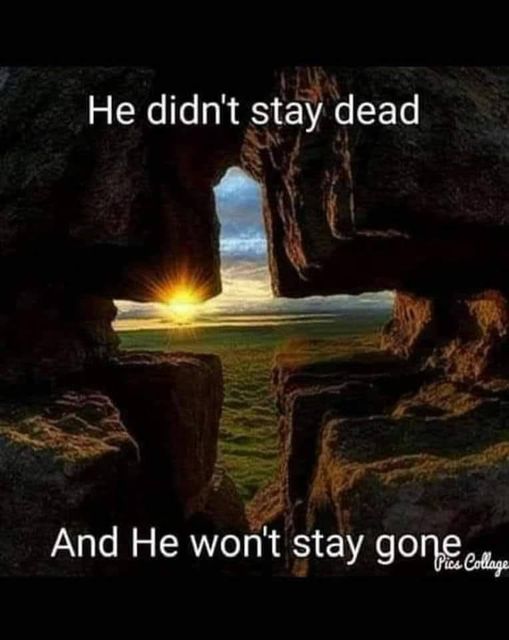
The good news is, that His death was only temporary. He was buried that day on Friday. But Sunday morning that tomb was empty. He was no longer dead.
Yes, He died taking on all the sins of mankind. Then He defeated death by God’s resurrection. That is what we celebrate this Sunday. Not the man on the cross. But the man who rose from the dead to give us forgiveness of our sins and eternal life with Him.
I hope this is what you will be celebrating this Sunday. And remember that even if you were the only person in the world, Jesus would have still done all this just for you.
May you say with complete confidence. He is Risen. He is Risen Indeed!
Happy Easter
——————————————————-
If you don’t know Jesus Christ as your personal Savior you can pray a simple prayer like this to accept Him as your Savior. ‘’Father, I know that I am a sinner and worthy of hell. I believe you sent Jesus to die for my sins in my place. I believe that Jesus rose again in three days and ascended to You in heaven to give me eternal life. I ask Your forgiveness of my sins. Jesus, please come into my heart as my Savior. I give my life totally to you. I repent of my sins and ask you to lead me. Thank you for hearing my prayer. Amen.’’
 Memories, Musings and Stories by Mike Grawvunder
Leave a comment