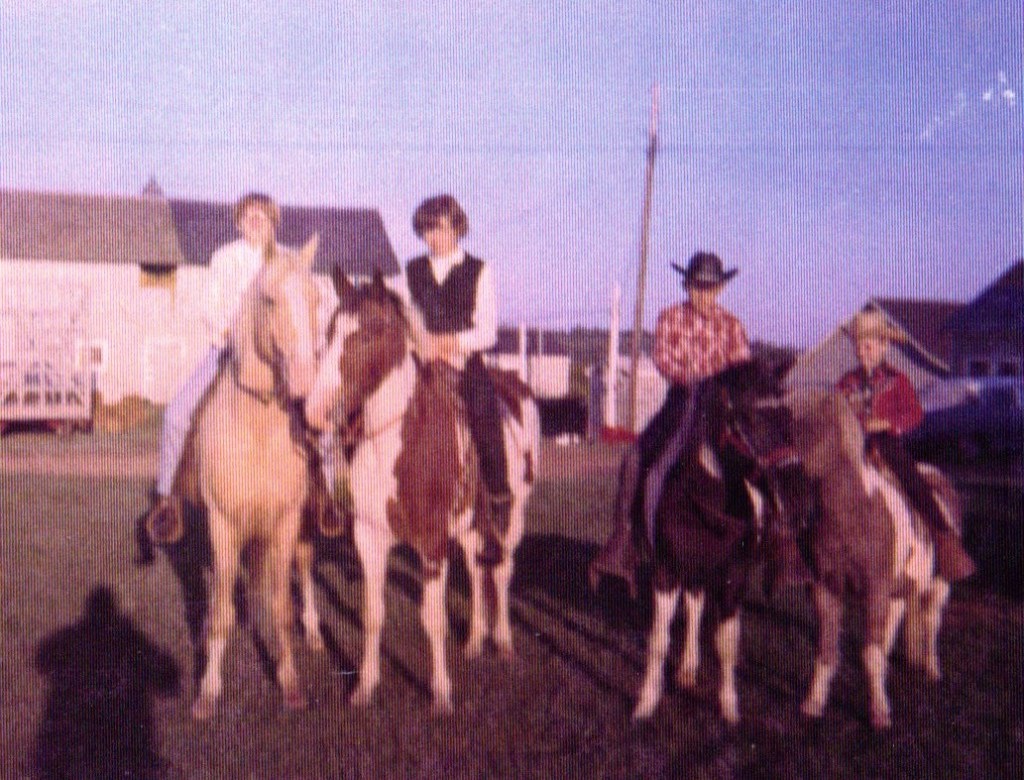
(Penny on Ben, Candace on Patches, Rob on Dolly and Me on Prince about 1968)
Dolly. That single word can bring a different thought or image to every person who hears it. For one, it might be the curly-headed child’s doll they played with as a child. For another, it may be a type of cart used to move boxes, appliances, or furniture around. For yet another, it might bring to mind a musical about a New York matchmaker.
I get a totally different image of remembrance when I hear that one word. It is the picture of a short, round, black-and-white Indian pony our family had when I was a child. We often joked that Dolly was about as round as she was tall.
She came into our lives when she was about ten years old, and I was about five years old, the youngest of four children. My next sibling was my brother, who was four years older than me. Dolly was the first horse I really remember our family having. There had been a couple of Shetland ponies earlier on, which my brother and two sisters had learned to ride. The Shetlands had left our lives before I was old enough to remember them much.
Dolly was a great horse with a unique personality. We have had many horses since, but I have yet to see one like her. She was a con artist, injury faker, and a master at making a novice look like a seasoned rider.
I had no experience with horses when Dolly arrived in our lives. At the age of only four or five, Mom or Dad could safely put me on Dolly’s back. I would take the reins in my little hands and Dolly would go wherever I wanted or do whatever I asked. We had some tires laid flat on the ground to teach Dolly to walk in the tires for a showdeo. A showdeo is like a rodeo for amateurs with fun events. Dolly would carefully step into each tire and go through the course like I was a master rider.
It was quite a different story when my brother or sisters mounted Dolly to ride. They could tug and pull the reins every which way and Dolly would often proceed to go the way she felt like going. Headstrong and stubborn were only some of her traits. Sometimes they would get so frustrated that they would want to give up. Then Dolly would begin to behave and do what was asked of her. She just had to show who was the boss.
One day my dad’s friend, Carl, and his family came out to visit. We were all outside as all the children rode Dolly while the adults visited. Carl had never ridden a horse so Dad talked him into riding Dolly. Again, Dolly knew somehow that she had a novice on her back and performed perfectly, almost. At one point Carl started to slip off one side. Dolly tried to help him by compensating to that side to help Carl get his balance back. Unfortunately, by that time Carl had been in the process of uprighting himself. When Dolly had moved quickly to the right to help Carl, she inadvertently threw him off her left side. He was unimpressed concerning horse riding and had no interest in trying again. He didn’t think it was as funny as everyone else who had been watching.
As the years went on, our family acquired more horses. Dolly became my brother, Rob’s, horse while I had a Shetland pony named Prince. Eventually, Rob got a large Quarter horse named Cherokee, Prince was sold and I inherited Dolly as my own horse.
So often I would go to saddle Dolly and she would puff out her stomach while I tried to cinch up the saddle. I would pull the cinch strap just as tight as I could, put my foot in the stirrup to pull myself up only to have Dolly suck in her stomach. I’d be on the ground and the saddle would be around Dolly’s side. I learned to poke Dolly in the side just before I cinched the saddle tight. She’d suck in her stomach and I’d have a tight saddle and not have another close encounter with the ground.
One of Dolly’s other tricks was the limp. I remember one time in particular that she had Rob and I totally fooled. By this time, we had moved to a farm in central Wisconsin and had a large pasture in which the horses ran. Rob and I walked out into the field and found Cherokee then set about to find Dolly. We found her in another part of the pasture, put the bridle on her, and started back toward the barn and tack house. Dolly started limping like there was something wrong with her front left foot. It was a slight limp, but we were concerned and checked her foot. Of course, we found nothing.
We got up to the tack house and saddled the two horses. Meanwhile, Dolly is standing like there is something really wrong with her foot. Again, we checked the foot and her frog just to be sure this wasn’t an act again. Nothing could be found wrong with her foot. We told her to quit faking and behave herself.
As soon as I got on to ride, Dolly’s limp proceeded to increase. Rob and I were just riding in the pasture that day and started out. We got down to check the foot a couple of times once we started to ride due to the limp, besides the previous times we had checked the foot while walking to the barn.
We got a quarter to half a mile from the tack house when Dolly’s limp got so bad, that she was almost throwing me off over her neck with every limp. We decided there must really be something wrong with the foot that we just couldn’t see. I unsaddled Dolly and took the bridle off. Then I slapped her on the rump and told her to take care of her foot. She did all right. She ran away as pretty as a punch. There hadn’t been anything wrong with her foot except that she didn’t feel like being ridden that day. Rob rode Cherokee next to me as I carried the saddle gear back to the tack house. Dolly had won again.
Years later we moved to town. We tried boarding the horses out for a while, but it didn’t work very well. We sold all the horses except for Dolly. For some reason, we just couldn’t seem to part with her. She stayed at my oldest sister’s farm for a while after Candace had left home and married. Then she stayed with a friend of our family for a short while.
Mom, Dad, and I finally wound back up on a little farmette. The landlord said he didn’t mind if we brought Dolly home. We couldn’t find a shipper to bring just our one horse home, so I rode Dolly the 20 or so miles back to our place. It was a fun experience for a 15-year-old boy with his old horse. I think Dolly enjoyed it also as it had been many years since the two of us had really done any riding together. Dolly was around 20 years old by this time, so we didn’t push the pace. I let her plod along and just enjoyed being with my horse again.
One morning several months later, we looked out and Dolly was nowhere to be seen. We were heartsick. Where could this old horse of ours have gone? I took the day off from school as Dad or Mom and I drove around looking for her. We traced the route that Dolly and I had taken from where she had been boarded. Nothing. There had been some stories in the local papers about that time of some sick people taking horses and mutilating them for whatever purpose. We were sick thinking this might have happened to our dear old horse.
We were taking one more trip back on the route Dolly and I had taken several months earlier. For some reason, Mom happened to look more closely at a herd of Holstein cows that were standing in a field. The farm was just before a bridge Dolly had not wanted to cross on our trip home.
Mom had Dad slow the car down. One of the Holsteins just didn’t look right. Since when did a cow have a rounded rump? Dolly had been hiding in the herd of black and white Holsteins every time we had driven past over the previous several days. Apparently, she still had not wanted to cross the bridge and thought she might as well hang out with the cow.
We brought her home again. Over the next year or so Dolly and I had more adventures. One sad day, Mom, Dad, and I came home to find that Dolly had died. It was a sad day. Dolly had lived a very long life though. We never knew her actual age for sure when we got her, but knew she had to be around 21 or 22 when she died. She brought much joy into my life and a lot of companionship.
I think we brought enjoyment to her life also. It’s not every horse that works so hard at outwitting its riders.


 Memories, Musings and Stories by Mike Grawvunder
Leave a reply to Jason Lawrence Cancel reply